
ADOPT A RESCUE RABBIT

Are you thinking about adopting a rabbit? Did you know …
- 4 out of 5 purchased during Easter or Christmas are dumped or pass away before their 1st birthday?
- The 3rd most popular and the 3rd most abandoned pet in the US.
- Are a 10+ year commitment.
- Need 3-4 hours of attention and care per day.
- $2,500 or more each year in food, supplies, and care.
- 4FT x 4FT (16sq ft) of living space per rabbit. Cannot be kept outdoors, in hutches, or in cages.
- Are exotic animals and require specialized veterinary care.
Adoption Fee: $100 / rabbit
The Truth About the Easter Bunny
80% of bunnies purchased for Easter are abandoned a few months later. Most will not survive to be 1 year old.
Every year after Easter and Christmas thousands of rabbits are abandoned in shelters or “released in the wild”, where they will not survive. Domestic rabbits lack the instincts to find food, water and shelter; many are hit by cars, attacked by predators or succumb to illness within days. Misconceptions that rabbits are cheap, short-lived, low-maintenance or good “starter” pets for children drive this tragedy.
#NotJust4Easter
You can follow YouTubers Lennon the Bunny and Sincerely, Cinnabun to learn more about life with a free-roaming rabbit.
Top 10 Mistakes Rabbit Owners Make
Rabbits & Children
MYTH: Rabbits are easy, low-maintenance or good “starter” pets for small children.
TRUTH: Rabbits are quiet, sensitive, and intelligent animals that can be reliably litter-box trained. They make wonderful companions for adults and responsible older teens. However, it’s important for parents to recognize that a rabbit is not, and never will be, a child’s pet. Rabbits are high-maintenance, exotic animals that require consistent, attentive, and detail oriented care. While children may enjoy helping occasionally, the primary responsibility will always fall on the parents. Parents hoping to use a rabbit to teach responsibility should proceed with caution, as it’s often the case that children loose interest or struggle to follow-through with daily chores, and its the rabbit who ends up suffering and neglected.
To thrive, rabbits must live indoors as part of the family. Ideally, they should be free-roaming like a cat or dog, or housed in a large x-pen placed in a central, high-traffic area such as the living room where they can be part of daily family life.
Unlike popular belief, rabbits are not naturally cuddly pets. Most do not enjoy being picked up or held. Their fragile spines and strong back legs make improper handling dangerous — both for the rabbit and for the child. A frightened rabbit may kick, scratch, or bite, and being dropped can lead to serious injury or even death.
Bringing a rabbit into your home requires consideration of your lifestyle (such as amount of time spent at home and frequency of travel), available space, and your children’s personalities. Rabbits are easily startled by loud noises and sudden movements and are best suited to calm, structured households with a set schedule. While some children over the age of 12 may be capable of learning gentle behavior and assisting with some care, rabbits are generally not a good fit for families with very young or high-energy children who struggle with boundaries and following set rules.
For families with children, medium to large breed adult rabbits are a better choice than young or dwarf breeds, as they tend to be calmer, sturdier, and less tempting for children to try to pick up. Spayed / neutered adult rabbits are more reliably litter-trained and have established personalities, which helps ensure a good match. Adopting from a rescue not only supports ethical animal care but also increases the likelihood of finding a rabbit that fits well with your family’s needs.
Want a Friend for Your Rabbit?
As a rescue we hear all to often of the pit falls people encounter on their bonding journey. Many people don’t realize that rabbits are extremely territorial and bringing a new rabbit home can lead to serious fights and injuries. Rabbits need to go through a weeks long, nuanced bonding process that can take 2 weeks or 2 months (or more) before they can live together safely. And not all rabbits can be bonded. Like people, some just don’t get along.
Check out our: [Intro to Bonding Rabbits]
TO APPLY:
- Must be 21 years of age or older and provide a driver license or state ID.
- Everyone in the household (spouses, parents, roommates, etc.) must agree to and participate in the adoption steps.
- Renters must provide written approval from their landlord and/or building to have rabbits.
1. INDOORS ONLY: Domestic rabbits should be housed and kept indoors at all times. Taking rabbits outdoors is not only stressful for them but exposes them to many dangers, such as: RHDV II, predators, parasites (fleas, ticks, mites, lice, fly strike, bot flies, etc.) and heatstroke (rabbits begin to show signs of overheating at just 76°F / 24°C).
- NO: patios, porches, backyards, or walks/outdoor playtime.
2. CENTRAL: The rabbits enclosure should be in an adults bedroom or a central, high-traffic area like the living room.
- NO: children’s bedrooms unless 13 or older, laundry room, kitchen, bathroom, garages, patios, etc.
3. FREE ROAM TIME: The rabbit cannot stay in the enclosure all of the time and will need 3-4 hours of daily supervised free-roam time to explore and exercise in an indoor “bunny-proofed” room.
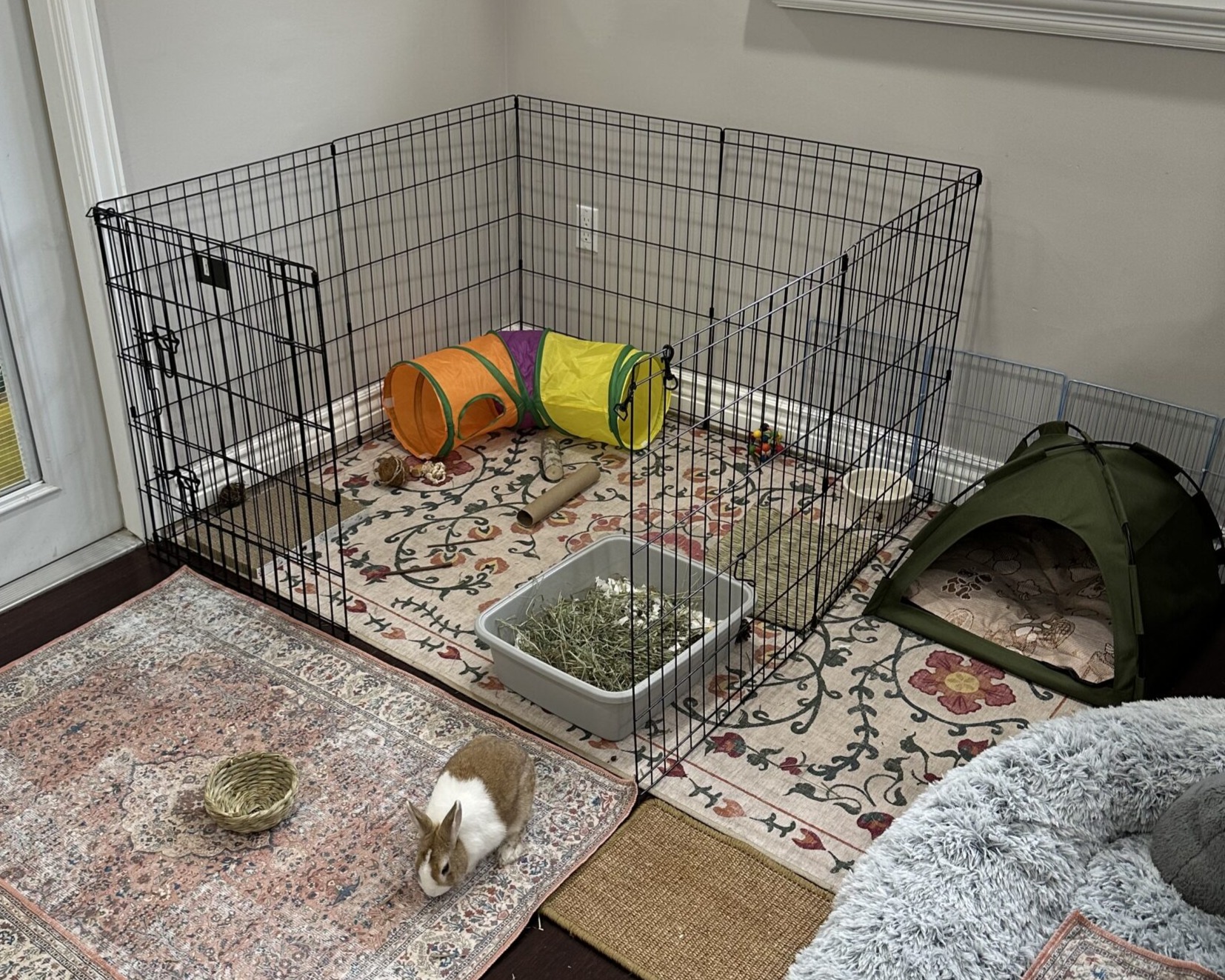
MINIMUM LIVING SPACE:
4ft x 4ft, 16sq ft 1 dwarf sized rabbit (2-4lb)
4ft x 6ft, 24sq ft 1 medium sized rabbit (5-9lb) or a pair of dwarfs
6ft x 6ft, 36sq ft 1 large breed rabbit (10-14lb) or a pair of medium sized rabbits
FREE ROAM giant breed rabbits (15lb+)
A single dwarf rabbit needs a minimum 4ft x 4ft, 16sq ft horizontal living space when enclosed, preferably 4ft x 6ft (24sq ft).
This will be their “home-base” for when you cannot supervise them. For each additional rabbit (or 4lb of body weight), add 8-12sq ft to their living space to maintain a healthy and harmonious environment and prevent fighting and bulling due to resource guarding amongst multiple rabbits. Giant breeds will need an entire room to free roam all of the time.
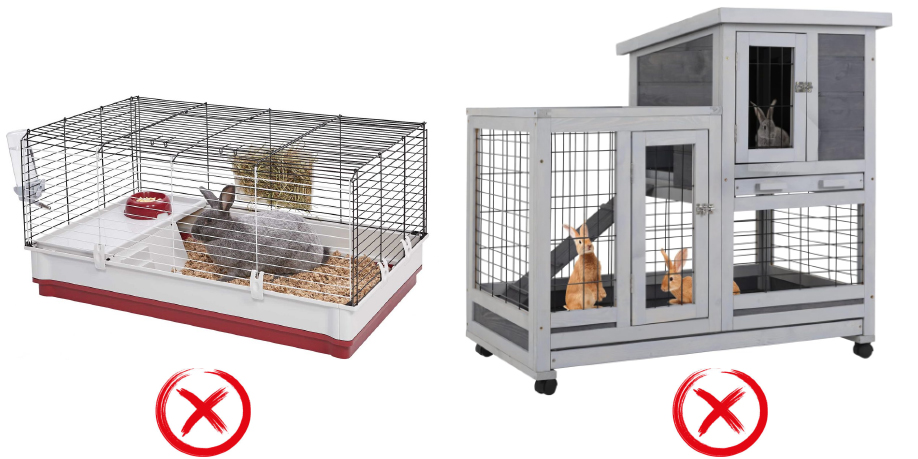
Cages and hutches DO NOT provide enough room for exercise and overall well-being for rabbits. Not providing enough space can lead to a host of problems due to depression and frustration. These often lead to rabbits pacing back and forth, cage chewing (which can damage their teeth), and cage aggression (growling, lunging and biting at hands that reach into their space or during cleaning). Health issues such as obesity, heart disease, muscle atrophy, skeletal changes, and infections are more common. Cages and hutches are also notoriously difficult to keep clean as rabbits end up using the entire space as a litter box.
1 | Habitat
Minimum 30-36 in tall, 4 × 4 ft (16 sq ft); preferred 4 × 6 ft (24 sq ft)
- Area Rug – min 5 × 7 ft
- Litter Box & Litter – min 14 × 18 in
- Ceramic Water Bowl – 3-5 cups
- Hidey House
2 | Diet
- Hay – Alfalfa (juveniles) or Timothy (adults), min 90 oz
- Pellets – Oxbow Adult / Young Adult
- Greens – Spring Mix
- Treats
3 | Toys, Enrichment & Grooming
- Grooming Supplies – nail clippers & brush/comb
- Enrichment – chew-toys, snuffle-mats, tunnels, puzzle-toys
4 | Carrier
Single dwarf (2-4 lb): 12 W × 18 L in
Single medium (5-10 lb) or pair: 15 W × 23 L in